Australia’s first hybrid ute brings premium features, with pricing from $75,000 for the game-changing eco-friendly workhorse
Ford is set to introduce a plug-in hybrid (PHEV) version of its popular Ranger ute in Australia in early 2025, marking a significant step in the electrification of the dual-cab ute segment. This Ranger PHEV aims to blend the practicality and ruggedness of the traditional Ranger with the efficiency and reduced emissions of a plug-in hybrid powertrain.


Powertrain and Performance
The Ranger PHEV will be powered by a 2.3-liter turbocharged four-cylinder petrol engine, paired with an electric motor. Ford has confirmed the electric motor will produce 75kW. While combined power and torque figures haven’t been officially released, there are speculations that the combined output could exceed even the Ranger Raptor, potentially reaching 297kW if the petrol engine isn’t detuned. The PHEV is targeting a fuel economy of 3 liters per 100 kilometers.
An 11.8 kWh battery pack will provide a targeted electric-only driving range of over 45km based on European WLTP lab testing. Ford’s internal data suggests that this range would cover the daily commutes of almost half of their customers, who travel less than 40km per day.
The plug-in hybrid system integrates the electric motor between the engine and a 10-speed automatic transmission, creating what Ford calls a ‘modular hybrid transmission’ (MHT). This MHT includes a separator clutch, allowing the vehicle to operate in full hybrid mode, blending torque from both power sources, or decoupling them for pure petrol or electric driving. Unlike some hybrid systems, the Ranger PHEV can send its full power to all four wheels under hard acceleration.

Towing and Payload
Importantly, Ford aims to maintain the Ranger’s current 3,500kg braked towing capacity with the PHEV version. Locating the battery pack between “specially engineered frame rails” helps minimize the impact on payload.
Pro Power Onboard and Drive Modes
A key feature is the Pro Power Onboard system, which allows the Ranger PHEV’s battery to power external devices, functioning as a generator. The system can deliver up to 6.9kW via one 2.3kW outlet in the cabin and two 3.45kW plugs in the tray.

Drive Modes
The Ranger PHEV will offer four hybrid-specific drive modes:
- Auto EV: Optimizes efficiency by blending petrol and electric power.
- EV Now: Operates solely on electric power for the stated range.
- EV Later: Preserves battery charge for later use.
- EV Charge: Utilizes the petrol engine to recharge the battery.
When the battery is depleted, the Ranger PHEV automatically switches to Auto EV mode, operating as a traditional hybrid, recuperating energy through deceleration. A Sport mode, borrowed from the Ranger Raptor, will also be available, sharpening throttle response and holding lower gears.
Design and Features
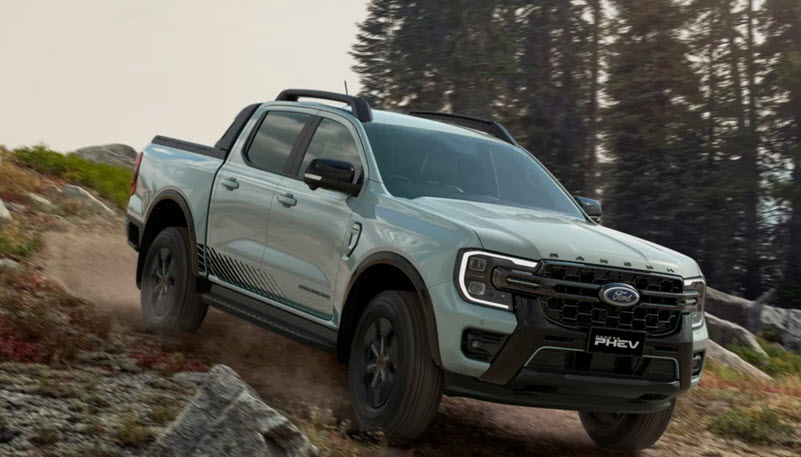
The Ranger PHEV will be available in XLT, Sport, and Wildtrak variants, along with a limited-edition Stormtrak model. The Stormtrak will feature unique design elements such as black 18-inch wheels, a distinctive front grille and wheel-arch vents, and exclusive paint options. It will also come standard with matrix LED headlights, a 360-degree camera, Pro Trailer Backup Assist, a premium sound system, and unique interior materials. A flexible rack system will also be included. PHEV badges will be present on the front wheel arches, in place of the usual ‘TURBO’, ‘BI-TURBO’ or ‘V6’ badging. The charging port is located on the rear-left wheel arch.
Production and Pricing
Unlike other Ranger models for Australia, the PHEV will be produced in South Africa. This means it will be subject to a 5% import tariff. While official pricing is yet to be confirmed, experts predict a premium of $10,000 to $15,000 over equivalent non-hybrid versions, potentially placing the XLT variant around $75,000 plus on-road costs, and the Stormtrak closer to $90,000 plus on-road costs.
Market Implications
The Ranger PHEV’s arrival is strategically timed, as it may be eligible for Fringe Benefits Tax (FBT) exemptions on plug-in hybrid vehicles in novated lease purchases if it arrives before April 2025. This could make it an attractive option for fleet buyers and individuals seeking tax benefits.
Pictures source: ford.com.au